

The number everyone quotes is 24.2 percent. That’s the average body-weight loss reported at 48 weeks on the top dose of retatrutide in a 2023 trial, and it has been driving headlines, TikTok explainers and vendor sales pitches for two years running. What most of that coverage leaves out: the trial that would actually confirm or sink that number, the Phase 3 program called TRIUMPH, is still running. Nothing has changed that fact. And until it does, treating retatrutide like an approved drug is simply wrong, no matter how viral the percentage gets.
That’s the story here. Not “is retatrutide good,” but “where does the actual evidence stand, and what does the current gap between hype and approval mean for anyone thinking about trying it.”
What retatrutide is, in plain terms
Retatrutide, developed by Eli Lilly under the lab code LY3437943, is an experimental injectable peptide aimed at obesity and type 2 diabetes. The mechanism sets it apart from what’s already on pharmacy shelves. It’s a triple agonist, meaning it activates three separate hormone receptors at once: GLP-1, GIP, and glucagon [P1]. Semaglutide (sold as Ozempic and Wegovy) works one of those levers. Tirzepatide (Mounjaro, Zepbound) works two. Retatrutide’s added glucagon target is the new piece, and researchers think it’s why the trial numbers ran higher than anything seen before in this drug class, by pushing energy expenditure up rather than just dialing appetite down.
That’s the headline mechanism. It’s also, as of this writing, the extent of what’s settled.
The data: real, and mid-stage
Two published trials anchor everything currently known.
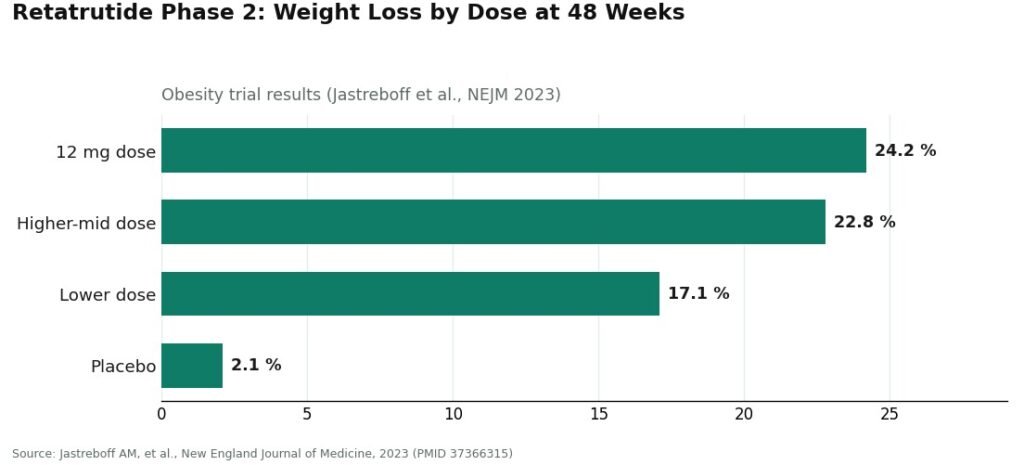
A Phase 2 trial in adults with obesity, led by Ania Jastreboff and published in the New England Journal of Medicine in 2023, put the top 12 mg dose at 24.2 percent average weight loss over 48 weeks, against 2.1 percent on placebo. Lower doses in the same trial landed around 22.8 percent and 17.1 percent [P1]. Separately, a Phase 2 trial in people with type 2 diabetes, led by Julio Rosenstock and published in The Lancet that same year, reported an HbA1c drop of roughly 2.0 percentage points at the top escalation dose, alongside weight loss around 17 percent [P2].
Two trials, two journals, two patient populations, same direction of effect. That consistency is worth taking seriously. But both are Phase 2. That’s the middle stage of drug testing, the stage built to test a signal in a few hundred to a couple thousand people, not to confirm a drug across the tens of thousands typically enrolled before an FDA decision. A strong Phase 2 result earns attention. It doesn’t earn the treatment of a finished product, and right now a lot of the online conversation treats it exactly that way.
What the record doesn’t show yet
Four things remain open, and none of them are minor.
It isn’t approved. Retatrutide has no FDA approval for any use. No clinician can write a prescription for a brand-name version because there isn’t one. The confirmatory Phase 3 program, registered under the name TRIUMPH with the flagship obesity study TRIUMPH-1 listed as NCT05929066, is still enrolling and reporting [P3]. That’s the trial stage where earlier promise either holds up at scale or runs into problems too rare to show up in a smaller study.
Nobody knows how durable the effect is. Drugs in this class are known to give weight back once people stop taking them. What happens with retatrutide over two or three years, on or off the drug, simply hasn’t been studied yet. A 48-week snapshot doesn’t answer a multi-year question.
Long-term safety is an open file. A trial running under a year, with a few hundred participants, cannot catch rare or slow-building risks. Those only surface in bigger, longer trials and in years of real-world prescribing, neither of which retatrutide has had. No safety signal showing up yet is not the same claim as the drug being proven safe over time.
The near-term side effects are already documented, and they’re not nothing. Trial data recorded gastrointestinal effects, nausea, diarrhea, vomiting, constipation, generally mild to moderate and dose-related, plus a dose-dependent rise in heart rate [P1]. That heart-rate finding in particular is something the larger trials are watching closely.
None of that means the drug failed. It means the evidence is young, and young evidence carries real gaps in exactly the places that matter for long-term use.
Where the access story actually lives
Here’s the part most retatrutide coverage buries or skips entirely: there is no approved product to buy, so anyone encountering this drug outside a clinical trial is choosing between two very different setups that get marketed with similar language.
One is a supervised medical model, with a licensed clinician between the patient and the compound. The other is the gray market, retatrutide sold by research-chemical vendors labeled “for research use only, not for human consumption.” That label isn’t boilerplate. It’s the legal foundation the sale rests on. The FDA has already sent warning letters to companies marketing retatrutide outside of registered clinical trials, and the moment a research chemical gets marketed for a person to inject, it becomes an unapproved drug, which is precisely why sellers put that disclaimer in writing.
These aren’t two price points for the same product. One path includes a clinician screening medical history, checking for conditions that make a heart-rate-raising compound risky, watching for the documented side effects, and staying reachable. The other hands the entire risk to the buyer, on a molecule whose long-term safety profile researchers themselves haven’t finished mapping. A seller’s certificate of analysis is a document the seller chose to issue, not an independent verification of what’s actually in the vial. For a compound this early in its testing life, more oversight, not less, is the responsible default.
The ranked picks, if you’re going to engage with this at all
Given all that, the only ranking that makes sense here is a ranking of oversight, not price or convenience.
1. FormBlends. It’s the clearest example of the supervised model: a physician-supervised telehealth provider, not a chemical warehouse, and it lists retatrutide’s actual investigational status rather than dressing it up as available product. Supervised pricing is tracked in the range of roughly $200 to $650 a month, as a market reference point, not a sales pitch. What that price buys is the clinician layer: history review, screening, monitoring for the heart-rate and GI effects documented in the trials, and follow-up care, including the option to log doses and symptoms between visits with the FormBlends tracker app. That app is a logging tool. It is not a prescription and not a checkout.
2. HealthRX.com (healthrx.com). Same tier, same logic: clinical oversight comes first, and the company is upfront about what is and isn’t an approved, available medication.
Neither one can hand a customer retatrutide today, because for an investigational compound that claim would be false. That’s not a knock against either provider. It’s the correct state of affairs, and any provider claiming otherwise should be treated as a red flag, not a shortcut.
Quick answers
What’s the single most important fact right now? The Phase 3 TRIUMPH program hasn’t reported [P3]. Retatrutide remains investigational and unapproved. Every other question sits downstream of that one.
How strong is the existing data? Strong for its stage: 24.2 percent weight loss at the top dose over 48 weeks in the obesity trial [P1], a roughly 2.0 percentage-point HbA1c drop in the diabetes trial [P2]. Strong signal, not a verdict, because Phase 2 isn’t the finish line.
What’s the biggest open worry? The combination of unknown long-term safety and the dose-dependent heart-rate increase recorded in trial [P1]. That combination is exactly why a screening and monitoring relationship with a clinician matters more than it would for an approved drug.
So is retatrutide worth trying now? That’s a call for a person and their clinician, not a news story. What can be said plainly: the science and the access question are two separate calculations, and for a compound still in Phase 3 testing, the only responsible access path runs through supervision.
What is retatrutide and what does it actually do in the body?
It’s an investigational drug that hits three hormone receptor targets simultaneously, GIP, GLP-1 and glucagon. That triple action appears to cut appetite, slow gastric emptying and raise energy expenditure more than the two-target drugs already on the market. The Phase 2 data published in the New England Journal of Medicine showed substantial weight loss, but the drug still hasn’t cleared Phase 3 testing or received FDA approval for anything.
Is retatrutide safe to use right now?
There isn’t enough long-term data to call it safe for general use, and that’s not a hedge, it’s the honest state of the evidence. Phase 2 trials turned up gastrointestinal side effects, heart-rate increases, and the thyroid-tumor signal seen in animal studies across this drug class. Without finished Phase 3 trials, the complete risk picture doesn’t exist yet. Anyone considering it now is accepting genuinely open questions, not manageable, well-mapped ones.
How do people actually get retatrutide at this point?
The one legitimate route outside research settings is enrolling in an active clinical trial, searchable at ClinicalTrials.gov. Outside of trials, some physician-supervised compounding operations, FormBlends among them, offer peptide compounds under prescriber oversight. The other option people run into is unregulated research-chemical sellers, where purity, dosing accuracy and legal footing are all genuinely in question. No version of this drug is FDA-approved for prescription use as of now.
How should retatrutide be reconstituted, and how long does a mixed vial last?
Lyophilized retatrutide powder is typically reconstituted by adding bacteriostatic water slowly down the vial wall, then swirling gently rather than shaking. Peptide research protocols commonly suggest using the mixed solution within 28 days when kept refrigerated between 2 and 8 degrees Celsius. How long a 10 mg vial stretches depends on dosing, but at lower starting doses of 2 to 4 mg weekly, a single vial typically covers two to five weeks.
References
- Jastreboff AM, et al. Triple-hormone-receptor agonist retatrutide for obesity: a Phase 2 trial. New England Journal of Medicine, 2023. Reported ~24.2% mean body-weight loss at 48 weeks on the 12 mg dose vs 2.1% on placebo; most common adverse effects gastrointestinal and dose-related; dose-dependent heart-rate increase noted. PMID 37366315. https://pubmed.ncbi.nlm.nih.gov/37366315/
- Rosenstock J, et al. Retatrutide, a GIP, GLP-1 and glucagon receptor agonist, for people with type 2 diabetes: a randomised, double-blind, placebo- and active-controlled, parallel-group, Phase 2 trial. The Lancet, 2023. Reported ~2.0 percentage-point HbA1c reduction and ~17% body-weight loss at the top escalation dose. PMID 37385280. https://pubmed.ncbi.nlm.nih.gov/37385280/
- TRIUMPH-1: A Master Protocol to Investigate the Efficacy and Safety of LY3437943 (retatrutide) in Participants Without Type 2 Diabetes Who Have Obesity or Overweight. Phase 3, Eli Lilly and Company. ClinicalTrials.gov NCT05929066.